
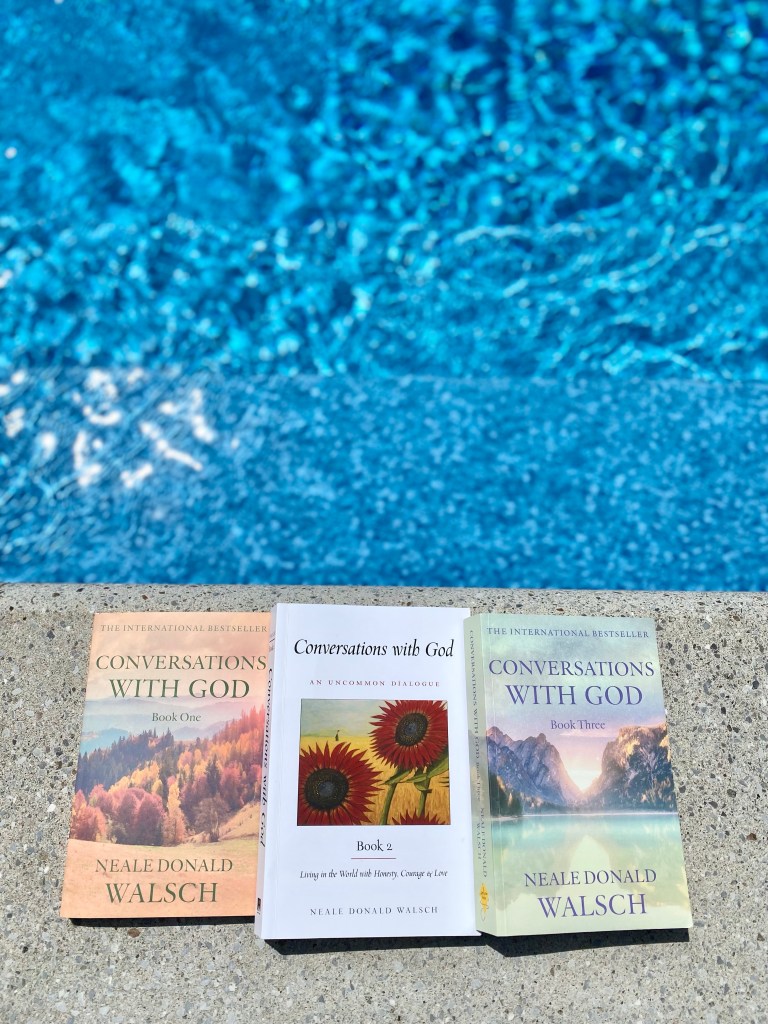
I know I’ve said this before when reviewing books but oh my am I excited and intimidated to review these three books. I know we all have our favourite genre of books to read, and as you may have guessed, spirituality and the world beyond this current life fascinate me. I could read fiction books that might entertain me, but where I find myself in life presently the only thing that calms me and intrigues me at the same time are books precisely like CONVERSATIONS WITH GOD. My husband says that I enjoy spending more time with the dead (or consuming content about the afterlife) than with the living. He may very well have a small point to make…
I devoured the first two books and read the third one painfully slow, sometimes even one page or a paragraph at a time because I knew it was the last book and I certainly did not want this conversation to end, ever. The concept of these three books are simple and yet extremely difficult for many to grasp. The author simply writes questions on paper (remember that concept?) to God and divinely receives answers to life’s grandest questions. The questions start off on a micro level and eventually develop into macro level concepts by book 3. Namely, issues pertaining to the universe, other planets and the state of the earth including political, social, and environmental issues that are affecting us currently (even if these books were written nearly 20 years ago!).
The author does not profess to being a prophet of any such form. Actually, he continuously questions his own process, his unworthiness, and fallible life that has led him to these divine conversations, which take place over a six year span. Each time God assures him that he is exactly where he needs to be and is the perfect person to be bringing about such messages. These books have sold in the millions and have been translated in multiple languages—so I guess God knew something the author did not.
Chapter 8 stood out for me in the first book which focused on relationships. It starts off with the message that relationships are entered to help us form who we really are and choose to be. This message is repeated throughout the trilogy, like many other positive messages so as to become second nature thinking—which is directly professed in book 3. That famous line that came out of Hollywood, ‘you complete me’ is grossly inaccurate according to this book. As you might suspect, you are whole and complete on your own and you choose to share this whole of you with another. You need no one to be complete, yet you cannot live without others. It is the greatest paradox of life itself.
It is believed that working on yourself, and all your grandest dreams, serves not only you but nurtures your relationships. It is cliché to repeat this but I will go right ahead and write it, you have to show love for yourself in order to have loving relationships—there is just no other way around it! We are not talking about conceited love or love with strings attached, but pure unconditional love of self. YOU should be your biggest fan!
For all difficult moments in relationships the following guidance is offered:
“For I tell you this: at the critical juncture in all human relationships, there is only one question:
What would love do now?
No other question is relevant, no other question is meaningful, no other question has any importance to your soul.”
CONVERSATIONS WITH GOD, Neale Donald Walsch
The love of self must be included when you speak of those you love most. Decisions, therefore, are not selfish when you truly love another as equally as you love yourself—your true self, namely your soul. Give to others what you give to yourself, and give yourself what you are willing to give to another.
This chapter does address abusive relationships and clearly states that abuse must not be tolerated, for it also teaches the abuser that their behaviour is unacceptable, and therefore gives the abuser room to grow and learn.
“Therefore, treating others with love does not necessarily mean allowing others to do as they wish. Parents learn this early with children. Adults are not so quick to learn it with other adults, nor nation with nation. Yet despots cannot be allowed to flourish, but must be stopped in their despotism. Love of Self, and love of the despot, demands it.”
CONVERSATIONS WITH GOD, Neale Donald Walsch
This chapter ends with a very candid conversation about the author’s uneasiness about being a messenger of God. It ends with both God and the author telling a joke about God and how others have doubted ever seeing God or knowing what God would say, pleading to the other person to just “…let me finish.”
The second book broadens the conversation to wars, world peace, and the notion of letting go of all fears, and how in turn that can solve all problems on earth. In chapter 11 specifically, it purports that all of life’s problems are spiritually based, and therefore can be solved when turning inwards, to our spiritual selves. For example, wars are created because someone has something that another desires. If we are able to find peace within ourselves then we will also discover what we can live without. If we have peace within we will no longer desire what we do not have because we know we do not need it in order to be at peace. This not needing leads to being free from anger because we fear not what we do not have (clear as mud? just stay with me).
“Anger is fear announced. When you have nothing to fear, you have nothing over which to be angry. You are not angry when you don’t get what you want, because your wanting it was simply a preference, not a necessity. You therefore have no fear associated with the possibility of not getting it. Hence, no anger.”
CONVERSATIONS WITH GOD, Neale Donald Walsch
Therefore, this concept of turning inwards to our own spiritual awakening could bring about world peace:
“This one simple change—seeking and finding peace within—could, were it undertaken by everyone, end all wars, eliminate conflict, prevent injustice, and bring the world to everlasting peace.”
CONVERSATIONS WITH GOD, Neale Donald Walsch
Chapter 13 is probably one of the shortest chapters, just over two pages, but one that moved me. The question is asked of how one begins to be a light in this world. The answer is a beautiful speech about living a life from a foundation of love—even when circumstances seem difficult to accept, or another person is being difficult or even hurtful.
“Why else do you think a person has come to you? I tell you this: every person who has ever come to you has come to receive a gift from you. In so doing, he gives a gift to you—the gift of your experiencing and fulfilling Who You Are. When you see this simple truth, when you understand it, you see the greatest truth of all:
I HAVE SENT YOU NOTHING BUT ANGELS.”
CONVERSATIONS WITH GOD, Neale Donald Walsch
Book 3 was probably the most mind boggling of the trilogy. It delved into realms of conversations that were sometimes difficult to believe actually came from God. I put the book down a few times to digest the information, but was drawn to it time and time again. It spoke of other worlds and other beings and how much more evolved they are from us, for all the reasons you might not imagine. Not just technologically speaking, but in how they communicate and where they place importance in their daily lives. The power of the mind to communicate telepathically (hey, stay with me here, don’t stop reading just yet!) and the peaceful way that they live their lives just by acknowledging that everyone is God in the flesh. Therefore, there is no desire to mistreat anyone for they understand that in mistreating another they are mistreating themselves, and therefore world peace is not a hope and a prayer, but rather their reality. The book goes on to explain in detail how their society is constructed. It all sounds very similar to the way of life of the aboriginal people, if I had to compare.
The idea of thoughts are more powerful than we could fathom was enlightening. The paradigm of the Be-Do-Have is mentioned in all three books.
“First you ‘be’ the thing called ‘happy’ (or ‘knowing’ or ‘wise’, or ‘compassionate’, or whatever), then you start ‘doing’ things from this place of being-ness–and soon you discover that what you are doing winds up bringing you the things you’ve always wanted to ‘have.”
CONVERSATIONS WITH GOD, Neale Donald Walsch
This book really drives home the idea of oneness and how thinking of ourselves as separate will continue to perpetuate the idea of ‘them’ versus ‘us’. If we truly believed that God lives inside each one of us (even the guy who seems odd on the subway for example) would we finally start to believe we are not separate, and therefore act differently towards others? Maybe treating others better? Possibly creating a world where peace is achievable in our present life time? The continued message throughout this book is how there is no such thing as ‘right’ and ‘wrong’. That we should judge not. I know, I know, you have heard this a million times before, but what if we did not judge anyone, ever again? Just think of the possibilities!
I had a few ‘Never Ending Story’ moments when the book felt like it was speaking directly to my soul. Namely, the book professes to be written for those to read it in their lives at the exact moment they were meant to consume the information—when they needed it most.
The book ends with many ideas on how we can start to live in a more unified way. Ideas that have been attempted in the past like abandoning large cities that are conducive to isolation rather than communal living—again very similar to the way aboriginals lived. All the things that seem so backwards to us now may very well be the way forward. All the advancements that we think we have made may very well be a step back from where we say we want to be as a society. We say we want this or that but we live and act in many ways that are not helping us achieve any of our goals. Then we wonder why we call them ‘ideologies’ because we are essentially stuck in the idea stages, primitive stages, infant stages of evolution. These books challenge every little and grand idea you have ever had about life, society, and the universe, and beyond. If you are ready to experience some hard truths, to look into a deep rooted mirror and question all that you think is your reality, then get ready to cease standing on the edge, and dive right in!
by Gilda Tavernese
 Thoughts At F___ It Forties